
A single photograph can feel incomplete, as if it is waiting to move, breathe or speak. Modern apps that convert still images into short video clips attempt to fill this missing gap by adding motion, depth and dynamic effects. This transformation has become appealing not only to creators but also to businesses looking for engaging visual content.
Understanding Image-to-Video Technology
The core idea behind image-to-video generation is simple but remarkably technical under the surface. The app reads pixels, identifies the patterns and predicts how objects within the picture might shift over time. Unlike basic slideshow tools, these apps actually simulate movement, giving life to a moment that never originally moved.
How AI Predicts Motion from a Single Photo
AI models trained on thousands of videos learn how various elements respond to motion. When a user uploads a picture, the system matches the elements with similar visual patterns from its training data. It then creates subtle animations such as blinking, flowing water, drifting clouds or body movement. These animations appear natural because they are generated through learned physics.
Popular Apps That Turn Photos into Video Clips
Several consumer apps now provide this feature with easy interfaces. Some apps focus on cinematic movement, adding camera-like pans and zooms. Others specialize in facial motion, recreating expressions or lip movement. A few platforms even allow users to script what kind of motion they want, making the output more personal and creative.
Why Creators and Marketers Prefer These Tools
Short-form video is the most consumed media format on social platforms. For many creators, converting images to video helps maintain a steady flow of content without constant filming. Businesses use these tools to animate product images, create reels and enhance ad creatives. This method reduces production cost while increasing audience retention and click-through rates.
The Technical Backbone Behind These Apps
Behind every smooth movement lies a complex network of neural models. They rely on depth estimation, motion prediction and frame interpolation. Depth estimation guesses what is near or far. Motion prediction determines the direction of movement. Interpolation fills missing frames to create fluid animation. These processes run in milliseconds on cloud servers.
Introducing Google Flow: The Engine of Predictive Motion
Google Flow is a framework built around understanding motion in a deeper, more precise manner. It originated as a research concept for capturing the flow of pixels across video frames. Over time, it evolved into a core component used in animation, video prediction and object tracking tasks across Google’s AI projects.
How Google Flow Interprets Pixel Movement
Google Flow analyzes how each pixel would move in a real video scenario. Instead of guessing blindly, the engine studies texture, edges and gradients to estimate motion direction and speed. This makes animations look natural, especially in scenes involving water ripples, hair movement or shifting shadows. Its accuracy is why many AI video tools rely on similar techniques.
The Role of Google Flow in Image-to-Video Apps
Many developers adapt concepts from Google Flow to improve motion quality. When a user uploads an image, the system calculates optical flow to map potential movement. This flow forms the blueprint for how scenes evolve. As a result, image-to-video apps achieve higher realism, especially when animating landscapes, portraits or digitally enhanced product visuals.
Enhanced User Control with Flow-Based Animation
Flow-based animation enables users to adjust how aggressive or subtle the motion should be. Some apps offer sliders that modify depth strength, camera angle or motion complexity. These features stem from motion field calculations derived from Google Flow research. This means users can fine-tune animations for marketing ads, personal videos or storytelling projects.
How These Apps Impact Digital Marketing Value
Animated images tend to attract higher engagement, especially on platforms where autoplay videos get priority. Advertisers benefit from increased impressions, better viewer retention and higher CPC revenue. Even a simple photo can be turned into a premium ad asset once motion effects are added. These apps help brands maintain a competitive edge in crowded digital spaces.
Prompt for Image
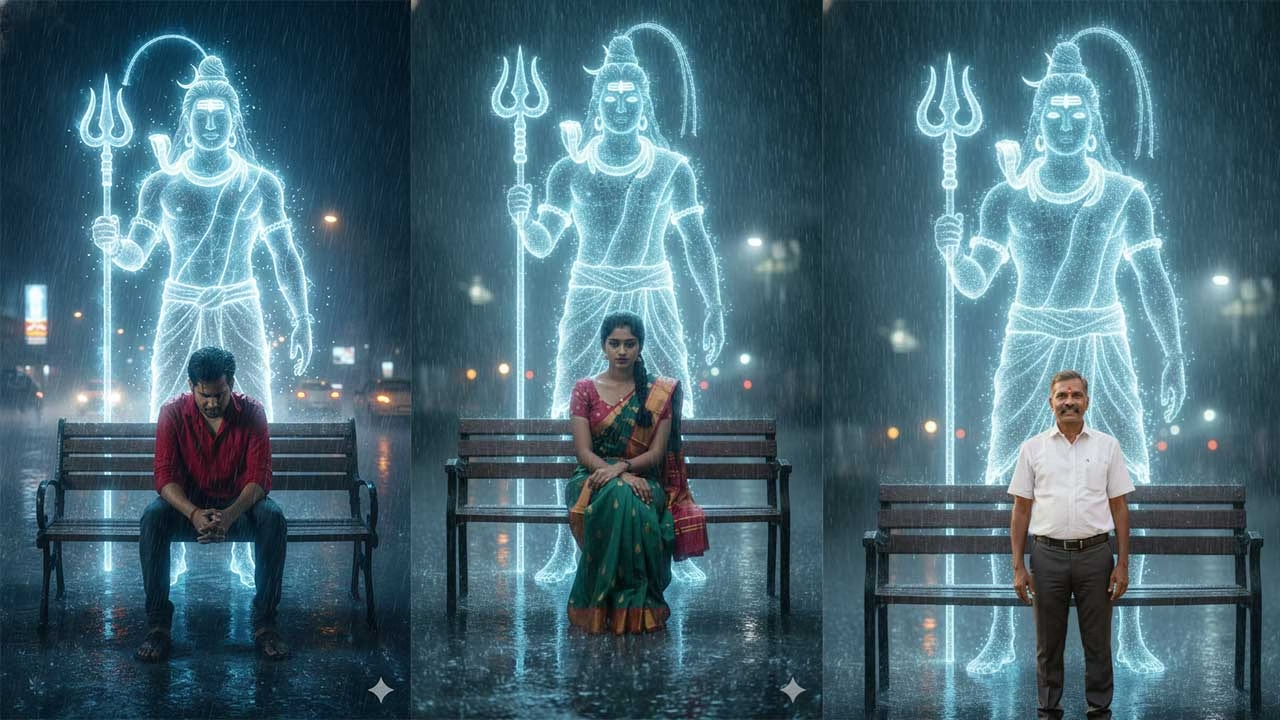
“A cinematic night-time scene in heavy rain, 1,751 with the person from the reference photo sitting on middle of a wet wooden bench, face should be 100 percent same no alternate from the original image, looking slightly sad and slightly downed his head, banch facing straight to camera and middle of the image. dramatic lighting, reflective ground, and a moody atmosphere. The glowing holographic made of blue-white light particles of Lord Shiva. The hologram lord shiva stands full body exactly behind of person and middle of photo, barefoot, holding his trident made of light energy, partially transparent, softly glowing, futuristic light lines and spark particles. while his other hand rests gently on the person’s shoulder. His form appears as an ethereal energy. The composition emphasizes emotional depth, contrast between the real person and the divine aura, ultra-realistic cinematic lighting, atmospheric rain effects, soft fog, and high-detail color grading.”
Prompt for Video
A cinematic emotional sequence continuing from the reference image: A young man sits on a wooden bench in the heavy rain at night, soaked and feeling deeply sad, head slightly lowered, expression showing pain and loneliness.
A single, glowing, divine, ethereal form of Lord Shiva stands permanently fixed behind the man, with his trident, made of blue spiritual light. Lord Shiva does not move or teleport and is always visible behind the man.
From this fixed position behind the man, Lord Shiva slowly extends only his right hand towards the man’s shoulder.
Focus on the Energy Transfer: Lord Shiva’s hand gently touches the man’s shoulder, and by this contact, he passes a wave of divine energy—offering sympathy and blessing. AT THE EXACT INSTANT OF THIS TOUCH, a powerful ethereal blue aura (the same spiritual color as Lord Shiva’s form and not an exact geometric circle) instantly flows from the touch point and fully surrounds the man. The entire area around the man remains dark and unchanged before this contact. This divine energy/aura instantly vanishes and completely disappears the moment Lord Shiva pulls his hand back from the man’s shoulder.
The man slowly lowers his head with a slight emotional relief, eyes becoming calm and hopeful. Lord Shiva maintains his position and gives a soft, reassuring smile, showing compassion and support.
The rain continues falling heavily, water dripping off their bodies, reflections on the wet ground shining beautifully under street lights. Camera moves smoothly around them with dramatic slow-motion shots. The atmosphere is spiritual and emotional, with divine light particles floating around Shiva, but his body remains pure and simple without jewelry. The man’s face and expressions should remain exactly the same as the reference image. Natural acting, realistic body movement, and emotional connection between them. Ultra-cinematic lighting, deep shadows, soft bluish glow, high-quality realistic rain simulation, strong emotional storytelling feel. 4K UHD quality.
Download App
Future Trends in AI-Driven Visual Creation
The next wave of image-to-video apps will likely integrate voice prompts, multi-angle generation and real-time editing. Developers are moving toward photorealistic animation that responds to user intent. As models evolve, they may animate entire scenes with advanced lighting and physics, making static images feel like scenes from actual recorded footage.